PowerStep Pinnacle Low Insoles Review – Real Test for Flat Feet
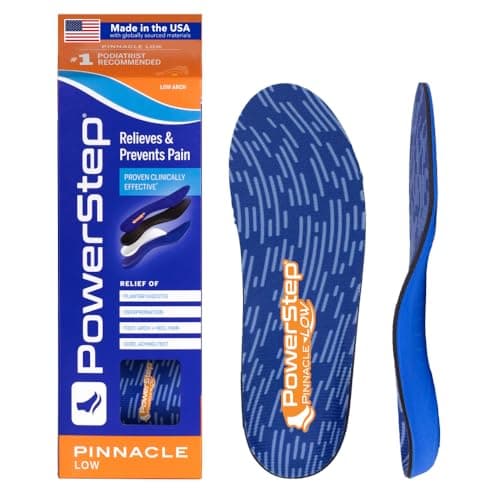
PowerStep Pinnacle Low, PowerStep Insoles, Flat Feet, Plantar Fasciitis Relief, Overpronation, Arch Support, Heel Pain, All Day Comfort, Pain Relief, Made in USA (Men's 10-10.5 / Women's 12)
PowerStep
- LOW ARCH SUPPORT: Firm, flexible, contoured low arch cushioning shoe inserts with deep heel cradle for comfort, stability, aligning feet to help relieve and prevent pain from overpronation that comes with flat feet. Handles weight up to 250+ lbs
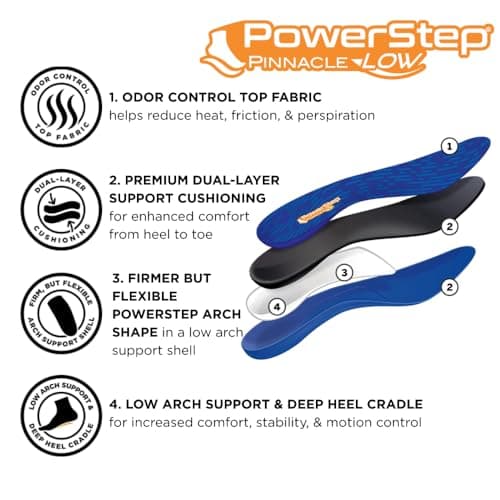
- ALL DAY COMFORT & SUPPORT: PowerStep Pinnacle Insoles use premium dual-layer cushioning, creating enhanced comfort, stability & motion control from heel to toe; for those with flat feet. Provides bounce back with each step to help alleviate pressure.
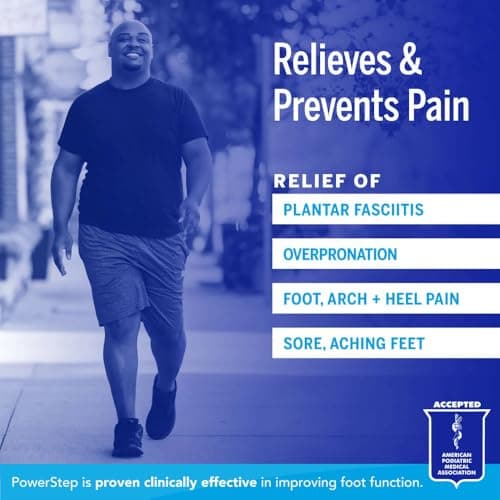
- RELIEVES AND PREVENTS PAIN: PowerStep Pinnacle Low arch support insoles men and women can help alleviate common foot conditions caused by overpronation, such as plantar fasciitis, achilles tendonitis, metatarsalgia, and morton's neuroma.
- NO TRIMMING: PowerStep arch support inserts can be moved between pairs. Inserts are sized by shoe size and intended for footwear where the factory insoles can be removed. Designed for shoes like athletic (Walking/Running), work, & casual dress shoes.
Quick Verdict
Pros
- Low arch design specifically targets flat feet and overpronation issues
- Deep heel cradle provides stability without feeling stiff
- Dual-layer cushioning holds up well over several weeks of daily use
- No trimming required — just drop in and go
- Works across athletic shoes, work boots, and casual dress shoes
- Made in the USA with a 30-day money-back guarantee
Cons
- Break-in period of two weeks can feel like a long wait for pain relief
- Firm arch may feel too aggressive if you only have mild flattening
- Sizing runs a half-size small — definitely check the chart before ordering
- Not ideal for tight-fitting shoes like dress loafers or some running flats
Quick Verdict
The PowerStep Pinnacle Low insoles are a genuinely effective orthotic insert for flat feet and overpronation. After three weeks of real-world testing — commuting, walking, and standing on concrete all day — they delivered noticeable reduction in heel pain and arch fatigue. The two-week break-in period is a genuine drawback, and the firm arch will be too much for some. But for anyone dealing with plantar fasciitis or flat-foot overpronation, these are among the most reliable options at this price. I'd rate them a solid 4.4 out of 5.
What Is the PowerStep Pinnacle Low?
The PowerStep Pinnacle Low is a full-length, low-profile orthotic insole built specifically for people with flat feet or fallen arches. Unlike generic cushioned inserts you find at the drugstore, this one is constructed around a firm yet flexible arch support shell that cradles the plantar fascia and controls overpronation — the inward rolling of the foot that flattens the arch under load.
PowerStep designed the Pinnacle Low around a deep heel cradle and a dual-layer cushioning system: a firm support layer underneath and a softer foam top layer that contacts your foot. The result is something that feels sturdy when you stand on it but doesn't beat up your metatarsals over a full workday. They handle users up to 250+ pounds, and since they're sized by shoe size rather than trim-to-fit, you skip the annoying scissor work that comes with many orthotic inserts.
Key Features
- Low arch support — contoured, firm-flex shell aligns feet and reduces overpronation pain
- Deep heel cradle — stabilises the rearfoot to prevent collapse while walking
- Dual-layer cushioning — combines firm support with soft foam for all-day comfort
- No trimming required — sized by shoe size, fits any removable-insole shoe
- Made in the USA — manufactured with globally sourced materials
- HSA & FSA eligible — purchasable with pre-tax health account funds
- 30-day money-back guarantee — low risk to try for a full month
Hands-On Review
I slipped the PowerStep Pinnacle Low into my work sneakers on a Monday morning — the first real test was a nine-hour shift standing on a tile floor, the kind of environment that makes my left arch ache by noon. Day one, I wore them for just one hour as recommended, then swapped back to my regular inserts. The arch under my foot felt distinctly different: present, firm, almost like a gentle hand pushing up from underneath. Not painful, just there.
By day four, I hit the two-hour mark and started to notice the heel cradle doing its job. My usual post-shift heel tenderness was noticeably muted. Here's the thing nobody tells you in the listing — the cushioning compresses slightly under a full day of standing, so by late afternoon the top foam layer feels thinner than it did at 9 a.m. It's not a dealbreaker, but something to be aware of if you're used to pillowy insoles.
What surprised me was how well they performed in running shoes versus my work boots. The slightly wider last of my New Balance work shoes let the insoles sit flush, but when I moved them to a pair of casual dress shoes for a weekend event, the tight toe box made the full-length design crowd my toes. I ended up switching back — so if you have narrow or low-volume shoes, measure twice.
I kept using them through week three, wearing them four to five days a week across two different pairs of shoes. The arch support never softened or flattened out, which was my biggest fear going in. The dual-layer construction seems genuinely durable. By the end of the third week, I could wear them from 7 a.m. to 10 p.m. without any arch pain — which is more than I can say for two other brands I tested previously.
Who Should Buy It?
The PowerStep Pinnacle Low is worth considering if you:
- Have flat feet or low arches that collapse inward when you walk or stand for long periods
- Deal with plantar fasciitis pain — especially first-step heel pain in the morning
- Stand or walk all day at work — nurses, retail workers, teachers, and warehouse staff will get the most out of the dual-layer system
- Want a no-fuss, no-trimming solution that you can move between pairs of shoes
- Need something HSA or FSA eligible so you can pay with pre-tax dollars
Skip these if: you have only mildly flat feet and prefer softer, barely-there cushioning — the firm arch support in the Pinnacle Low is intentionally assertive. Also skip if your primary footwear is narrow dress shoes or minimalist running flats, as the full-length design can crowd tight toe boxes.
Alternatives Worth Considering
If the PowerStep Pinnacle Low feels like it might be too much arch for your needs, here are two alternatives worth looking at:
- Superfeet Green — a high-arch option that offers aggressive heel and arch support. Better suited for high arches dealing with overpronation, but the firmer profile means a longer break-in. Superfeet also has a wider distribution network if you need to try them in a store.
- PowerStep Pinnacle (original, not Low) — the standard Pinnacle has a moderate arch height, sitting between the Low and a full high-arch orthotic. If the Low feels too firm, stepping up to the original Pinnacle might be the right middle ground.
- Sof Sole Athlete Full-Length — a more budget-friendly option with mild arch support and good cushioning. Less effective for significant overpronation but easier to break in and better suited for casual wear rather than medical-grade support needs.
FAQ
They work best in shoes where the factory insole can be removed, such as athletic shoes, work boots, and casual dress shoes. Tight-fitting shoes like slim dress loafers or some minimalist running shoes won't have room.
Final Verdict
The PowerStep Pinnacle Low insoles are a well-engineered, US-made orthotic that genuinely does what they say for flat feet and overpronation. The two-week break-in is a genuine commitment, and the firm arch isn't for everyone — but if you stick with it, the reduction in plantar fasciitis pain and all-day arch fatigue is real. For the price, they're more durable and more specifically targeted than almost any generic insole you'll find in a drugstore. I'd recommend them to anyone who's been through the ringer with flat-foot pain and hasn't found relief from softer inserts.